



















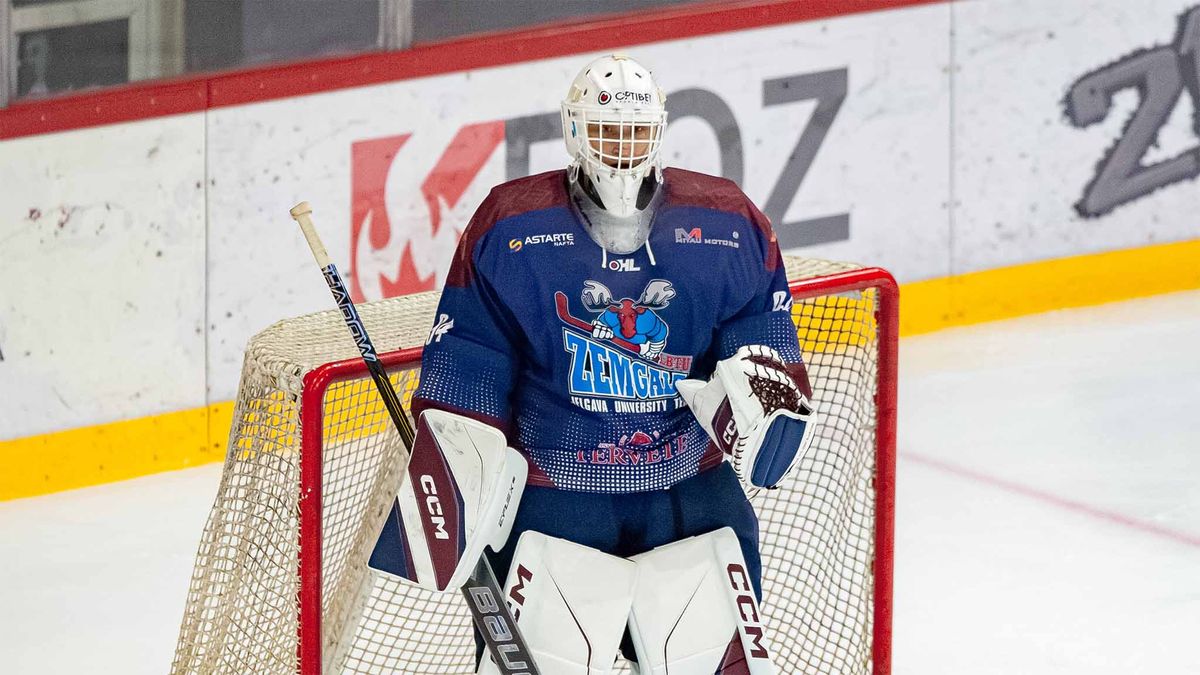
With the 114th overall pick in the 2026 NHL Draft, the Toronto Maple Leafs have selected goalie Patriks Plumins from Zemgale of the Latvian Hockey Higher League.
This is the second goalie selection of the 2026 Draft for the Maple Leafs, coming after the selection of Juuso Ainsato in the third round. The pick used to select Plumins originally belonged to the Anaheim Ducks. It was first traded to Seattle in exchange for Brian Dumoulin two years ago, and then was dealt by the Kraken to the Leafs at the trade deadline in the deal that sent Bobby McMann to the Emerald City.
Plumins, who checks in at 6’3.5″ and weighs 214 lbs., is an 18-year-old goalie who was something of a riser in this draft class. He was unranked in the Elite Prospects Draft Guide, receiving a “D” — a late-round draft grade. He was on some radars, however, checking in at 75th on the McKeen’s draft rankings and 55th on Christ Peters’ draft rankings. When you get outside the top 100 picks, the concept of a “steal” or “reach” selection begins to fade away as you select players you like for one reason or another.
The reason to like Patriks Plumins: what he did this past season. He played primarily in the Latvian Hockey Higher League, the top (men’s) professional league in that country, after having mostly been a junior goalie previously. Across 16 games with Zemgale, Plumins posted a .927 SV% and a 1.50 GAA. If those numbers sound good, it’s because they are. Both were the best in the league by any goalie, although Plumins’ workload was less than many of the goalies (who played 20-30 games).
The performance of Plumins in Latvia is impressive, but admittedly, very few people follow or scout that league at all. There are only so many Latvians in the NHL as it stands, and most all come through a stronger European or North American league before they arrive in the NHL. Thus, what likely put Plumins on the Maple Leafs’ radar was his performance at the U18 World Championships in the spring.
At an event with many scouts in attendance, Plumins was exceptional. Ilja Nikitins began the tournament in net for Latvia, giving up six goals to Canada, but then Plumins took over; he held Finland to two goals on 35 shots, saved 24 of 25 against Norway, and stopped 36 of 40 against Slovakia. That was enough to get Latvia out of relegation territory and into the knockout round, where Plumins put on a real show. He stopped 43 of 45 shots against the mighty United States, knocking the Americans out of the tournament in a stunning upset (Latvia was outshot 45-16 in that game).
In the next game, Plumins got his rematch against Slovakia and played better this time, stopping 21/22, but it was not enough in a 1-0 defeat. That set up the Bronze Medal Game, where Plumins stopped 24/26 in a 4-1 (two ENGs) defeat to Czechia. Though Plumins went home without a medal, he didn’t leave empty-handed: he was named to the U18 Tournament All-Star Team and voted the Best Goaltender. Cumulatively across the five games, Plumins posted a .947 SV% and a 1.62 GAA, while his team was decisively outshot in every contest.
The performance at the U18s earned Plumins a mention in a column by Sportsnet’s Jason Bukala about five players rising up draft boards in the spring. Bukala wrote, “The foundation Plumins has to work with is attractive. His combination of size, coordination, lateral explosiveness, and overall battle stood out for me.”
From a size standpoint, 6’3.5 is certainly a solid profile, and the statistics back it up.
The Elite Prospects Draft Guide said the following about Plumins:
A very strong positional goaltender, Plumins is physically built for professional hockey, with a mature 6-foot-3, 203-pound frame. He challenges shooters well, framing his hands and legs effectively as he cuts down the angle and re-adjusts his depth accordingly to keep the net covered as the play crashes in. Strong on his posts, he transitions quickly into the RVH seals well from that position.
He also uses his stick effectively on the post, cutting away passing lanes and disrupting puck carriers with an active stick. He tracks pucks well with his glove hand, directs rebounds with his butterfly, and anticipates well, constantly scanning for threats.
While he has good athleticism, his recoveries are affected by being slow to get up. Whether an athletic or alertness issue, his engagement level can wane over the course of 60 minutes. He can also struggle to adjust his angle on the fly and rely only on his depth. Additionally, he can act late on his reads, and will need to ensure his scans inform his play-reading – again, possibly an engagement issue. While normally composed, when Pl?mi?š becomes erratic, his positional and technical base sometimes falter after he loses sight of the puck or faces significant adversity.
Here’s a compilation of Plumins’ performance against the USA at the U18 tournament:
Like Ainsato, this is another developmental goalie who is a long way off as the Leafs look to re-stock the pipeline. Latvia has quietly become a solid goaltending nation despite its extremely small size, so there is some reason to think they might be doing something positive in their goalie development as it pertains to Plumins. Elvis Merzlikins has been in the NHL for some time, and Arturs Šilovs joined the NHL with Pittsburgh this past season.
However, the next step for Plumins will be graduating to a much stronger league where he can face better competition. Whether that’s coming over to North America and playing in the CHL, or staying in Europe and playing in a country like Sweden or Russia with superior players to those he saw in Latvia, I don’t think it matters. But a step up in calibre of shooters will be necessary as Plumins’ development continues. Like with Ainsato, it is always a good idea to take fliers on goalies; you never know what they could turn into, and at this stage of the draft, they’re all stabs in the dark.
Patriks Plumins Scouting Report
via McKeen’s Draft Book (BUY NOW)
Already possessing the kind of dreamy size coveted in modern goaltenders, Plumins entered the season well off the draft radar. Despite posting fantastic regular-season numbers for his Zemgale pro team, they came in just 16 games in one of Europe’s least prominent and least scouted leagues. He also suited up for Latvia’s U20 team (recording one shutout win) and U18 team (posting a 1.60 GAA and one shutout in five appearances) in various friendlies over the winter. However, he truly burst onto the scouting scene at the U18 World Championship, particularly after carrying Latvia to the bronze medal game with a stunning 5-2 quarterfinal victory over the United States.
That may have been the highlight, but it came after he first saw action in Game 2 of the tournament and proceeded to hold Finland to two goals and Norway to just one. A gold-medal game appearance was thwarted in a 1-0 semifinal loss to host Slovakia, marking the third time in the tournament that his teammates were shut out. The 4-1 loss to Czechia in the bronze medal game included two empty-net goals. Altogether, Plumins’ performance earned him the tournament’s Top Goaltender award.
Technically, it’s easy to see why Plumins was so successful. He displays outstanding up-and-down movement, exceptional puck-tracking ability, strong post integration, and a snazzy glove hand. Clearly a student of the position, his stick and pad saves consistently direct pucks away from the slot, allowing him to excel at limiting rebound opportunities in the crease. His lateral movement looks effortless, at times giving the impression that he’s simply floating across the ice. The one caveat is that Plumins’ sample size remains extremely small. The scouting community is largely projecting off the strength of this one tournament, but it’s hard to find anyone who isn’t excited to see what he does for an encore.
Assistant GM Judd Brackett on Patriks Plumins
Brackett: He had a very good U18 tournament in April. We like the size, compete, and athletic nature.