
























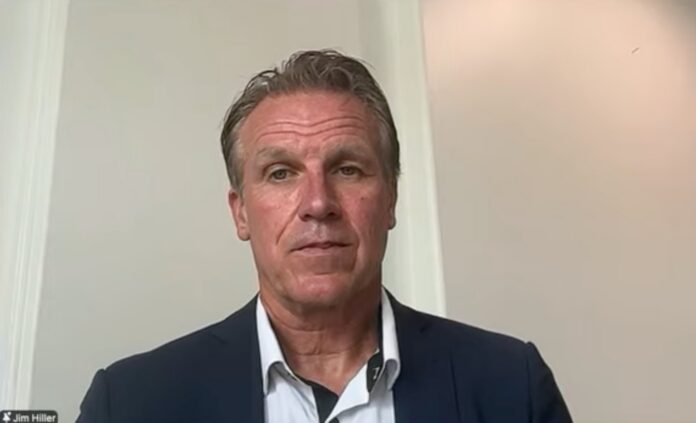
After his introduction as the 41st head coach in Maple Leafs franchise history, Jim Hiller discussed rejoining the organization, his past experience in the market, coaching the Leafs’ star players, the opportunity to draft first overall later this month, and the style of play he’s looking to implement.
Opening Statement from Jim Hiller
Hiller: First of all, from my perspective, I’d like to thank John, Mats, and Keith Pelley at MLSE, as well as ownership, for giving me what is an opportunity of a lifetime. It really is.
I am a BC boy — not an Ontario boy — who grew up sitting on the couch with my dad, with my greatest memories of hockey being watching the Leafs and the Canadiens, all across Canada on Hockey Night in Canada. Those are the greatest memories you could take forward, and to sit in this chair and represent his organization—I can’t tell you how much pride I have in that.
Before I go too far, there are so many connections with the Leafs and the Leafs’ history. I have many of them, but there is one that really jumps out to me, and that is Cliff Fletcher.
When I first joined the Maple Leafs as an assistant coach, we went to Halifax for training camp. DJ Smith, an assistant coach, and I got to sit with Cliff one night. We ended up spending a little more time after dinner. DJ and I, over the years, have referenced that as one of the greatest nights in hockey, just listening to Cliff share himself with us, tell stories, get to see the person and the humility, the caring, and the pride he had in the Leafs. It is a night we reference and will never forget. I know a little bit of time has passed, but it brings a huge smile to my face and warms my heart to think about Cliff Fletcher and the Toronto Maple Leafs. I wanted to mention it because I think he really embodies what we’re all trying to do and be here with the Leafs.
On the next topic, I am sure this will be brought up, so I just want to talk a little bit about my philosophy on the team and on the coaching.
Where I believe the biggest impact a coach can have is on guiding the spirit of the team. It is the most important. The foundation of any team is how the spirit strengthens and grows during a season. To me, everybody who is involved and can touch the team in certain ways has some input and some influence on how that grows. The players, of course, have the greatest influence, but we, outside of that, have to support and understand that as that grows, the team grows.
That is where a lot of emphasis will be placed: on recreating, reigniting, growing, and strengthening the spirit of the hockey team. When you leave the dressing room with that, it translates directly onto the ice.
What does that look like? We could go into a thousand different areas of the game and what it might look like, but for me, the simplest one is skating. I believe skating is the first chain in competing. When you get on the ice and you’re skating, it is back, it is there, it is quick, it is stopping. As quickly and hard as you can do things, that’s how you start to know the spirit of your team is starting to grow.
Never mind the offensive structure or defensive structure; all of those will be in place, but they’re a byproduct of the spirit and the skating of your hockey club. We can talk about that in more detail as time goes on, but I just wanted to make sure I was really clear on that as the emphasis of where I see the challenge of the coach.
Finally, when John (Chayka) called me quite a while ago, I got off the phone, and my wife asked me, “Who was that?” I said, “That was John Chayka, the GM of the Toronto Maple Leafs.” She said, “Oh no, the media!” I said to her, “No, I know those people. I’ve been there. Those are all really nice people.”
With that, I will open it up to questions.
Q&A with Jim Hiller
You talked about growing the team’s spirit and its importance to the standard of success. How do you go about trying to establish the standard and secure the buy-in for the way you believe the team needs to play? How difficult a job is that?
Hiller: It is what the job is, in my mind. There are many facets to it.
How do you get that accomplished? It doesn’t just happen. I shouldn’t say it; there will be a certain spirit — every year, there is a certain level of spirit — but how do you try to grow it?
Those are the coaching tools you have. It is the communication. It is the relationships. It is defining, very clearly for everybody, what the standards are. It is when people reach milestones in their game, whether it is offensively or defensively, and it is celebrating those milestones.
There is a whole bunch that goes into it. There is not one, two, three, or four things. But, really, it is about making sure it is very clear and also celebrated. It has to be celebrated. The game has to be fun.
When you start doing things and stacking them up on top of each other, once you start feeling success and when everyone is doing it together in a certain way — whether it is out of your comfort zone or not — the spirit naturally starts to grow. And everybody feels it — everybody who has been on a winning team, everyone who has maybe had more success than people might have thought they would, has felt that and knows that feeling of, “This was special for some reason,” or, “This year maybe wasn’t as special for some reason.”
A lot of times, it is with the same group of players, but it changes from year to year. The job is to set it, celebrate it, and help it grow.
There has been a lot of curiosity about the 1-3-1 you deployed in Los Angeles. What is your tactical style, for those of us who don’t know? How are your tactics different than Craig Berube’s?
Hiller: There are relatively subtle, different tactics or systems throughout the league, but they are mostly pretty subtle. There is mostly a pretty standard template across the league that all coaches play with. In the end, I don’t believe that one is necessarily better than the other.
I will draw it back to the spirit of the team and the commitment. If everybody does everything together and feels good about it, there is room to play different styles within that. That is not job one. Job one is to get the team to play, thrive, and be excited to play whatever style or system there is.
I’ve done a bunch of different things. I’ve coached with coaches who have tried things a little bit differently. We will experiment with all of that, but I don’t think I could tell you exactly what this system or that system we’re going to play at this point. We’re early.
We’ll have lots of discussions. We’ll have a style of play that the players will be excited to play in. I think that is most important.
You’ve talked a lot about the emotional and mental parts of the game over the years. How do you think that will serve you as you enter a more pressurized hockey market?
Hiller: I think, having been in Toronto already, will help, for sure. Now, I wasn’t the guy who had to talk to the media every day, but I certainly paid attention, watched, learned, and met a lot of you folks along the way. That experience, having already been there, will really help.
I said this to my wife, and I am not trying to oversimplify: When you are a coach in the NHL, before and after the game, you talk to the media. There is a microphone, and whether there are three microphones or 15 microphones, three cameras or 15 cameras, you have to answer the same questions.
It is bigger. There is more volume of media. There is no question. But how you approach it—your honesty, your relationship with [the media]— doesn’t change.
I know it is a big job and a big market, but it is not something where I am personally going to have to change much to deal with.
This team has a couple of superstars in their prime, Auston Matthews and William Nylander. How many, if any, conversations have you or John Chayka had with them about this hire? How do you expect to maximize their offense?
Hiller: I haven’t talked to them at all. This has been a relatively tight process. We have kept that very tight as far as keeping it between a very small group of people. I look forward to talking to them.
There is no question; you guys know I spent a lot of time with those guys when they were breaking into the league with young players. I have great, great respect for them. I love to see how they’ve matured, evolved, and everything they’ve accomplished in the game so far since I left them.
I am sure I will be getting to them very, very soon.
The Kings posted really good defensive numbers while you were in LA. How do you apply it to the Leafs now? To what degree does the blue line specifically need to be reshaped so you can get the most out of the group? Are you anticipating that these types of changes will come before you apply what you want to do properly in camp?
Hiller: It is relatively early here in the process for me. What I would say is that if you just go back a season, the Leafs played some really good hockey. A lot of the same players who played on that team are currently on the roster. They played extremely well. I remember playing them. We had great games against them.
I just think it is really early. We have to take just a little step back and say, “There are some really good hockey players in that locker room.” You’ve mentioned Auston and Willy, who are a couple of stars in the league, no question. But you can go up and down and see some tremendous players in there — guys who have played a lot of years with a lot of blood, sweat, and tears. There is leadership. And they’ve accomplished a lot as individuals in the game so far.
It will run its course. There will be conversations. John will explain to me what he can and can’t do. But I am not here to tear up the roster. There are good players there. They’ve shown that in the league.
What is the status of the returning or still-under-contract assistant coaches?
Hiller: I’ve got to talk to everybody. John and I have been talking about that. I’ve got to get numbers. I will work on that as soon as we get through today. That will be part of my next step. We will see where everything goes.
How do you use data and integrate it into coaching or tactics?
Hiller: Data, information, analytics — I don’t know what the right word is for any of that, but I am very open to it. I have long thought that, as difficult a game as we play to try to measure and understand a little bit better than we have in the past, it is a challenge. But it’s a worthy challenge.
I am always looking and open to trying to find ways we can find more information just to really inform us — to test, backtest, think about, and maybe just create a better discussion in the coaches’ room or coaches and management room to ultimately make a better bet, whether it is playing style or player acquisition or whatever it might be. Those really help to inform. In my experiences, they just help you have better discussions and point you in better directions.
I look forward to that. I beleive that is also a strength of mine because I have had such an interest, and I know John has with his background also. I think it is something that is really easy for us to communicate about.
How do you feel about starting with such a big advantage with the first-overall pick? How might your experiences with younger versions of Matthews, Nylander, and Marner help you in the coming experience?
Hiller: First of all, I have to tell you, I was at arm’s length, but I was really excited when the Leafs won the draft lottery.
I take it back to my time there. I know what the odds are. We were fortunate enough then to land Auston, and I think it was only 25% at that time. This time, it was significantly less. What an exciting moment that was. It made me relive the draft lottery when Auston was the number-one pick.
It is extremely exciting, not only for me — and I am sure not only for John — but for all of us who are a part of and love the Leafs. It is hard to get the generational talent on your roster, and any time you are picking at #1, you have a great chance of doing that.
Obviously, I look at Auston as a shining example of that, with what he has done so far. I am sure he will be there to support whoever gets picked.