


















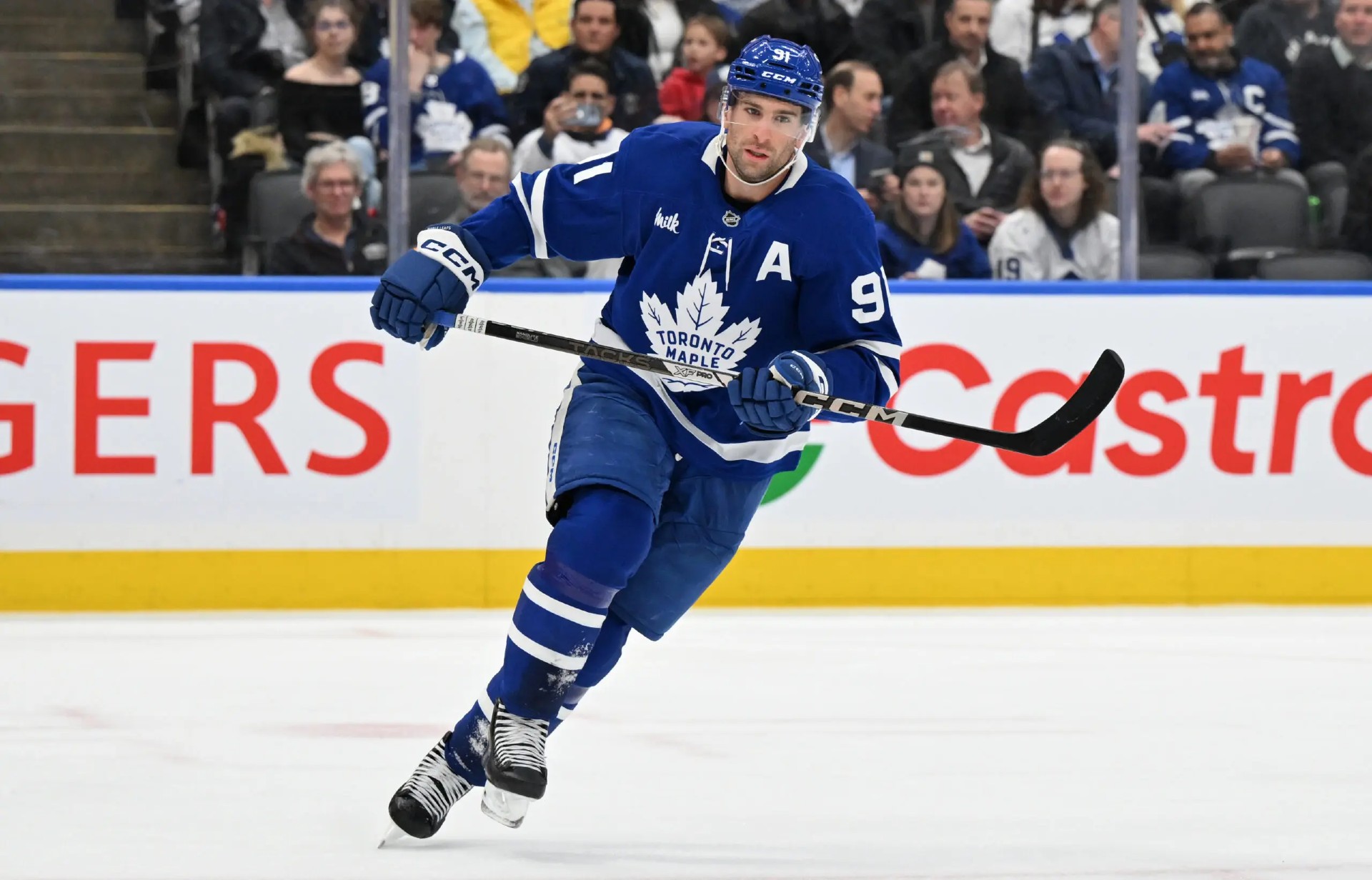
There is probably no Maple Leaf who deserves more goodwill from the fan base right now than John Tavares.
A year after fully embracing the decision to hand the captaincy to Auston Matthews — handling a potentially awkward situation exactly as you would expect him to — Tavares signed what immediately looked like one of the most team-friendly contracts in the league: four years at a $4.38 million cap hit. He left significant money on the table to remain in Toronto, and in my opinion, the CRA should recognize the haircut Tavares took in the name of trying to bring the Stanley Cup back to Canada.
Then Tavares went out and made the contract look even better in 2025-26.
Tavares played all 82 games, scored 31 goals, and finished with 71 points. On a Leafs team for whom very little went according to plan, he simply continued to produce. At $4.38 million, there isn’t much more you could reasonably ask for offensively.
It also wasn’t an offensive season built largely around a couple of heaters. Tavares’ production was fairly steady throughout the year. Even over his final 30 games, as the Leafs’ season completely unraveled around him, he was the consummate pro, recording 12 goals and 27 points.
At 35, playing on a team that was a mess for significant stretches of the season, 31 goals and 71 points is excellent production. Full stop.
But there is an important distinction between appreciating what Tavares accomplished offensively and pretending there aren’t legitimate questions about how the Leafs should use him moving forward.
The -28 rating jumps off the page. Plus-minus is obviously an imperfect statistic, and this was hardly all on Tavares. His on-ice save percentage was unusually poor, and Toronto’s defensive structure was a disaster for long stretches. Still, there were underlying issues that can’t simply be dismissed as bad luck or circumstantial. At this stage of his career, Tavares doesn’t consistently drive play through the middle of the ice, and his lack of foot speed can become exposed when he’s asked to handle difficult matchups at center.
We raised exactly this issue frequently during the season. While the offensive value remained high, we honestly questioned at times whether Tavares should continue as a full-time top-six center.
Therein lies the rub with Tavares entering 2026-27. He is still a really good offensive player. He can finish. He remains an elite faceoff man — he won 57.5 percent of his draws last season — and he’s still a power-play weapon around the net and in the bumper. He knows how to find quiet areas, protect the puck, win battles around the crease, and bury when his linemates put the puck into good areas for him.
What he increasingly isn’t is the player you want asking to carry a line from Point A to Point B.
We saw a compelling example of the potential solution late in the season when Tavares played between Easton Cowan and William Nylander. The line controlled play and outscored the opposition 12-4 over one dominant stretch, with Cowan and Nylander doing much of the puck transportation and Tavares able to play to his strengths. As we noted at the time, having two wingers who can skate, carry the puck, and make plays made Tavares’ life significantly easier.
Maybe that’s not the exact line/those aren’t the exact linemates, but that is probably the blueprint with Tavares now. Ideally, the Leafs would have another center capable of absorbing tough-matchup responsibilities while deploying Tavares in a more offensively tilted role. We outlined this scenario before free agency: acquire a legitimate center and push Tavares into a heavily offensive role alongside players such as Cowan or Gavin McKenna.
The Leafs didn’t acquire that player, per se. Nick Paul might give them another legitimate NHL center who could help with the defensive workload, but John Chayka didn’t add/couldn’t easily acquire the type of high-end center who clearly pushes Tavares out of the 2C spot. That means Jim Hiller will probably have to get creative rather than simply deploying it straight up (the top sixes head-to-head), as Craig Berube often did.
Maybe Tavares still technically centers the second line, but a Paul-centered line takes on more difficult defensive assignments. Maybe Tavares occasionally shifts to the wing. Maybe he centers a line that is treated more like an offensive third line depending on how the other combinations shake out. The number or label attached to the role/line isn’t as important as the deployment approach.
There is also a conversation to be had involving Gavin McKenna. There are obvious stylistic differences between the rookie winger and the 35-year-old center, but there are also some reasons to believe they could work well together. Neither needs to play at a frantic pace to create offense. Both are comfortable slowing possessions down, holding onto pucks, and allowing plays to develop around them.
It’s difficult to imagine a better veteran for McKenna to learn from. Tavares, the first overall pick in 2009, entered the league carrying enormous expectations, became a franchise player almost immediately, served as captain in two passionate hockey markets, and has built his entire reputation around preparation and professionalism. He returned home at the peak of his prime and embraces all that the Toronto market brings. For a first-overall pick entering Toronto at 18 years old, there is real value in having that guy sitting next to McKenna on the bench all game.
There could be on-ice value in pairing them together, too, with the right additional linemate. Tavares can’t be the player carrying the puck through three zones. He can arrive underneath the play, work the offensive zone, get to the net, win draws, and finish chances. This is the basic principle that made the Cowan-Tavares-Nylander combination so interesting late last season: surround Tavares with players who can skate and move the puck, and let Tavares do the things he still does extremely well.
None of this should diminish what Tavares accomplished last season. If anything, the fact that we’re discussing how to optimize a 35-year-old who just scored 31 goals and 71 points while earning $4.38 million speaks to how strong his value still is.
There will eventually be a steeper decline. Father Time is as of yet undefeated. The question is whether the Leafs recognize and act on it early enough to stay ahead of it rather than waiting until Tavares clearly can’t handle the role anymore.
He doesn’t need to drive a second line for 84 games to justify his contract. He doesn’t need to take on difficult matchups consistently. He doesn’t need to be the player lugging the puck through three zones. The contract means the Leafs don’t have to ask him to be any of those things.
They can treat Tavares for what he is: A highly intelligent veteran scorer. An elite faceoff man. A power-play weapon (although it’s wait-and-see as to whether Tavares, who has recorded five straight 20+ power-play point seasons and was second on the team in PP points with 21 — one behind Nylander for the team lead — can consistently remain a part of PP1 with Darren Raddysh and McKenna coming to town). A complementary offensive piece who can still produce at a high level when placed with players capable of driving play around him.
At $4.38 million, and with all of the intangibles Tavares brings to the room, that’s still a really valuable player.