


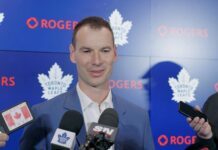


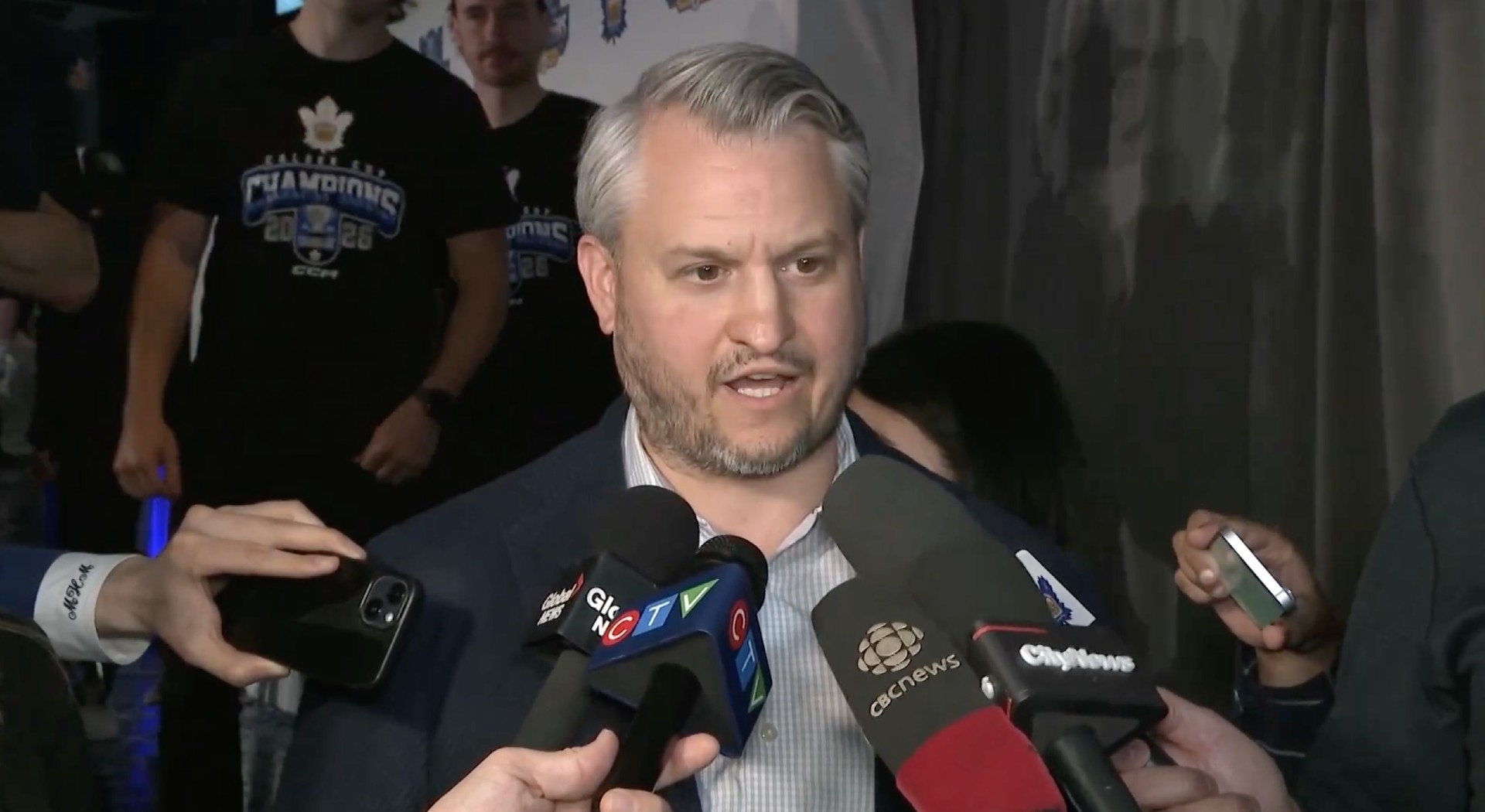
At the Toronto Marlies’ Calder Cup Rally, GM Ryan Hardy discussed his team’s amazing accomplishment, the support from the city, and the decision to wear a Rodion Amirov jersey on the ice after the Calder Cup-clinching victory.
There is so much credit to go around after an accomplishment of this magnitude. How many people had a hand in this?
Hardy: It is impossible to quantify, really. For the guys who are here, the guys who were here before, the fans, the city, all of the staff — I took way too much time speaking (at the rally), but I could’ve gone for hours. This has been incredible.
The team went from 15th in the regular season to champions. Can you speak to the belief this team had from the beginning?
Hardy: [Logan Shaw] and I have been arguing about that. We were also eight points out of first in the division. The American League is a funny thing where you rarely have the same roster for every game. I always knew that if we had our best team together, had our group, and everybody in the right chair, with the leadership we had and the people we had, we had a chance.
That being said, through three rounds, I think we played the maximum amount of games. I kept saying, “Maybe we can get these done a little sooner.” If you add it all up, I think we played three fewer than the maximum in five series. What these guys accomplished was incredible and really special. It is something that I’ll remember forever.
During the season, the Marlies are overshadowed by the Maple Leafs. As the spring progressed, what did it feel like to be in the building as it became a reality?
Hardy: The Rochester series was three games. Those can always go any way. When we were on the road in Laval in Game 5, down in the third period, and scored twice to win, you were starting to be like, “Okay, maybe we have something here.”
And then it happened again in Cleveland when Shaw and Vinni came over the line. We had lost Marc Johnstone; I don’t think people have any idea, but he might be the most underrated player in all of hockey. He was out with an injury in that series. Cleveland outplayed us for most of that series. Lettieri and Shaw found a way to tie the game, and when Cowboy put it home with 11 seconds left, you were kind of like, “Oh, boy.”
These things just kept building. It started to feel like destiny. It started to feel like this was coming together.
What was great was that the building started to fill a little more, with the excitement of the World Cup and so many things going on. Just standing on the ice 20 or 30 minutes after the game, listening to these people and how much it meant to them…
As I said, this is a hockey city. There is no place in the world where hockey matters more. Sometimes, a lot gets made about the media coverage or the social media, but everything has its equal and opposite. For all of the negative noise, when you have moments like this — and hopefully, when the Leafs get it done — the equal and opposite is true, and this will be a magical time in this town when it happens.
You could really feel with these guys as it built throughout the playoffs.
When there is a lot of negativity around the Leafs, how do you make sure it doesn’t trickle down to your locker room, with so many players moving up and down?
Hardy: It is a great question. It is nice for me — I fly under the radar; my wife and I can go to any restaurant, and no one really bothers us — but for the players, it is what you sign up for when you come to Toronto.
It is always amazing to win. Credit to our opponent; they won the Stanley Cup, and then they went to the Finals in the Calder Cup.
I think it is a small group that gets negative, and a lot of the time, it is opposing fans. So many people love the Leafs, and so many people hate the Leafs. For us and for our players, you have to want to be here. It takes a certain kind of person. But it is the most special place there is, if and when you can get it done.
You wore the Rodion Amirov sweater during the celebrations. Can you speak to what it means to honour him in this way?
Hardy: Rodion was drafted the year before I came. I said this the other day, when I was asked after the game. [Brendan Shanahan] and [Kyle Dubas] had brought him here with the hope of his getting to play an exhibition game, knowing the situation he was in. When he got here, it was clear that the situation was worse.
This kid… They told him while he was here that his diagnosis was terminal. He believed, and he kept always referencing God — that God would look after him. He was lying on the training table in the Marlies’ room the day after, and I went in there and said, “Hey buddy, how are you doing?” In very broken English, he had a smile from ear to ear, and he said, “Good.”
That is something that will never leave me. For a kid — whose life should’ve been so different, who should’ve been able to live out all of his dreams here in this city — to have his life end in that way, way before it needed to, to still have such positivity and radiant energy…
The connection to Artie just tied it all together, and it couldn’t have been more perfect.
It was probably five o’clock in the morning when all that went down over in Russia. I hope his parents and sister woke up and took a lot of pride that his memory will live here forever.
Marlies GM Ryan Hardy wearing a Rodion Amirov Jersey. A nice touch. pic.twitter.com/mGnsyJqiPe
— David Alter (@davidalter) June 20, 2026