
















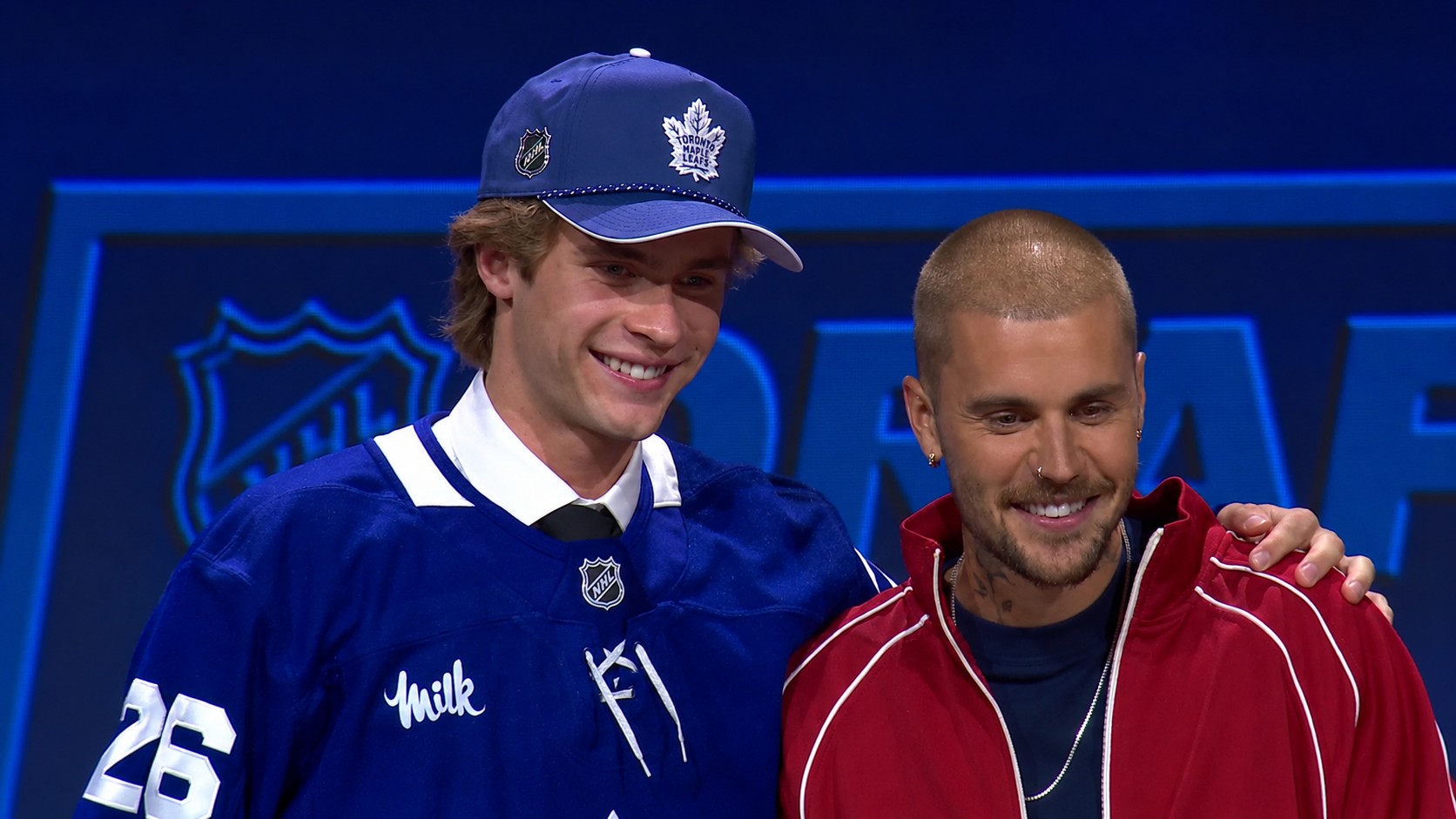
Never in doubt. Gavin McKenna is officially a Toronto Maple Leaf.
There is a lot to unpack with McKenna’s hockey skill set and on-ice résumé, but particularly in the wake of the last year or so in Toronto, the personality and character fit is also a highly relevant consideration for any young star arriving in this city.
Fortunately, McKenna checks plenty of boxes in that department. His poise and self-assurance in his media interviews exude maturity, which is perhaps unsurprising for a kid who moved away from his family home in Whitehorse at age 12 to pursue his hockey dreams.
Now, McKenna is no John Tavares-style hockey robot, personality-wise. Certainly, someone who broke out the Conor McGregor strut as his goal celebration shortly after his bar-fight incident at Penn State isn’t as reserved by nature. But he has dealt with and embraced the spotlight for a long time now, and he is confident enough in himself—who he is, what he’s capable of, where he comes from, and whose opinions really matter—that it gives reason to believe he probably won’t spend his time worrying about the noise. And when he does encounter it, it likely won’t make him wonder whether any of the criticism—inside or outside the market—might actually be true. If anything, it seems more likely to fuel his fire.
"If I'm not drafted [by the Sabres], I want to be a villain wherever I go."
Gavin McKenna on the idea of becoming a villain in Buffalo. pic.twitter.com/rSVsvJAWZV
— Sportsnet (@Sportsnet) June 25, 2026
This is an important personality trait for a high-profile player in Toronto, as we’ve learned all too well since a certain individual’s cut-and-run exit last summer. McKenna is still an 18-year-old with plenty to learn about navigating the pressures and expectations that come with playing in both the NHL and Toronto—we’re not naive here—but he is, by all accounts, starting from a good foundation, with a palpable swagger to his general disposition.
It also won’t hurt that the Leafs have three former first-overall picks in the organization—two in the dressing room and one in the executive suite—available to guide and mentor him as he makes the jump to the NHL.
McKenna’s hockey story has been full of resilience—it’s in his roots. His grandfather survived the residential school system, and his Indigenous background gives him a broader perspective and a keen awareness that he’s playing for something much bigger than himself. He is an undersized player raised in a remote part of the world who, at 12 years old, moved away from his family to British Columbia, where he broke both his hands in the span of a couple of weeks — enough to send most kids his age running back home. Instead, he dominated the CSSHL and then, as an exceptional-status player, the WHL at a level only a handful of all-time CHL greats have ever reached in their age 15-17 seasons.
In his draft year, McKenna made the riskier decision to head to Penn State and further develop his game against older competition, against whom he initially struggled (by his own standards, as he still produced around PPG). He treated the World Junior tournament as a reset opportunity, produced 14 points in seven games for Team Canada, and then tore it up down the stretch of the college season, recording 32 points in his final 17 games largely against power-conference opposition. By the end of the season, McKenna tied for fifth in the NCAA with 51 points (15 goals, 36 assists) in 35 games and ranked second in points per game at 1.46 as the sixth-youngest player in men’s college hockey—one of the most impressive pre-draft seasons in NCAA history.
The Toronto Maple Leafs select Gavin McKenna with the 1st overall pick. Incredible playmaker, great vision. Tore it up in the second half at Penn State.
Led the country in offensive zone possession, zone entries and finished 2nd in points per game. pic.twitter.com/Y3trB8tNRm
— Mike Kelly (@MikeKellyNHL) June 26, 2026
“What is really amazing to me is that he put up those numbers while playing with about 10 different linemates all over the place. He just did a tremendous job, and I’ve never seen anything in college hockey like what he did in the second half of the season. He really dominated in a way that I have never seen.”
– Penn State head coach Guy Gadowsky
When it came time to decide on World Championship participation, McKenna opted out and focused instead on his physical and mental preparation for the draft combine, where he crushed both the fitness testing and the interviews.
Which brings us to today. Gavin McKenna is officially the first-overall selection in the 2026 NHL Draft and the newest Toronto Maple Leaf.
So, what are the Leafs getting on the ice? From MLHS’ own Alex Drain:
McKenna’s vision, puck skill, and offensive hockey IQ are things you simply cannot teach. They are special gifts—the ability to use whatever time and space he is given to open up devastating passing lanes for teammates. He slows the rapid, breakneck pace of the game down and makes everyone else play at his speed. McKenna can attack on the rush with every other player sprinting at full speed, calmly pull up, probe, and then slip a pass through seemingly impossible lanes.
When McKenna has the puck, he controls the tempo, and everyone else follows. His challenge won’t be playing too fast or too recklessly, as is often the case with young players. Instead, it will be adjusting to NHL defenders taking away time and space and learning how to create it for himself—a process he also experienced this season at the NCAA level. Playing a bit more directly will be part of that evolution as well because, at times, he looked for the most difficult deke instead of making the simpler—and correct—play.
In terms of his other tools, I wouldn’t describe McKenna as a particularly fast skater. He’s better on his edges than he is in a straight line, though he certainly isn’t a poor skater.
His shot is also worth discussing. He shot just 9.9 percent this season. Compared to other elite forwards who played college hockey, his finishing numbers were relatively modest. I’m not entirely sure what to make of that because, at times, I actually thought he relied on his shot a little too often. Looking back at his WHL production, I think the Patrick Kane comparisons are fair in the sense that he projects more as a 25-to-30-goal scorer who piles up assists than as a pure finisher. His shot is good, but it’s not an elite weapon.
If there’s one concern about Gavin McKenna, it’s his performance in the biggest games. I don’t really blame him for Penn State not winning anything despite having him on the roster, because that feels more like a broader coaching and roster-construction issue. Still, I would have liked to see a little more in those marquee matchups.
He had a three-point performance in the outdoor game against Michigan State but managed just four points in the other eight games against Michigan and Michigan State combined, and he was held off the scoresheet in Penn State’s NCAA Tournament loss. McKenna wasn’t simply stat-padding against weaker competition, but I would have liked to see a little more production against the very best teams.
Of course, it should also be said that Guy Gadowsky leaned on McKenna far too heavily. In the Big Ten semifinals, he played 27:30 in a 60-minute regulation game, and a month earlier against Michigan, he logged a ridiculous 28:07. He regularly played between 23 and 25 minutes per night down the stretch, and I do wonder whether all of the double-shifting forced him to conserve energy during certain stretches or contributed to some of his quieter performances. He may have simply run out of gas late in games.
The structure at Penn State did McKenna no favors, and it will be up to his NHL team to manage him properly in 2026-27.
Needless to say, players with McKenna’s upside can change franchises.
The particularly exciting part, both for McKenna himself (as he has referenced multiple times) and for the Maple Leafs and their fans, is that he’s joining a team intent on competing right away. There is still work to be done this offseason before the Leafs can return to playoff form, but McKenna certainly injects new life into a nucleus that currently includes Auston Matthews, William Nylander, John Tavares, Matthew Knies, Darren Raddysh, Chris Tanev, Jake McCabe, and Oliver Ekman-Larsson.
A gifted playmaker, McKenna now joins a team with two veteran centermen who are first and third in the NHL in total goals scored over their respective NHL careers (Matthews and Tavares). He’ll likely join a top power-play unit that features Matthews, Nylander, Tavares/Knies, and Raddysh, as a left-handed passer on the flank feeding a right-shot QB with a bomb from the top, as well as a collection of high-end shooting forwards. A first-overall talent on an entry-level contract is a transformative addition for any franchise, but it’s especially exciting when there is real hope of meaningful, competitive hockey starting as soon as this coming Fall.
As exciting as all of this is, within those competitive ambitions, the development approach will need to be handled tactfully by John Chayka and the management staff, Jim Hiller and the coaching staff, and the organization’s development team. McKenna is mega-talented, but he is not an 18-year-old Auston Matthews blessed with a 6’3 frame and demonstrated acumen and engagement off the puck. Hiller referenced it himself the other day; his experience coaching Matthews, Nylander, and Marner when they broke the league is helpful, but no two players are the same developmentally. Holding McKenna to a high standard, helping him grow to his immense potential, but also living with the inevitable warts, all while winning hockey is the expectation, presents a balancing act to navigate for all involved.
That aside, there was a better-than-91-percent chance we wouldn’t be sitting here writing these words today — and much better odds the Leafs would be watching from the sidelines as the Boston Bruins made a top-10 pick in their place — so be sure to soak it in, Leafs Nation: Gavin McKenna is a Toronto Maple Leaf.
Gavin McKenna Scouting Report
via McKeen’s Draft Book (BUY NOW)
Gavin McKenna has been under a microscope for years. Ever since he was 14 years old, he has been talked about by members of the media. It’s very easy to understand why, with him scoring a casual 65 points in 35 games in the CSSHL U18 with RINK HA Kelowna. He was selected first overall in the WHL Prospects Draft and followed that selection with even more stardom.
He once again dominated the CSSHL U18 level at 15 years old, this time to the tune of 75 points in 26 games, including 37 goals. He made the jump to the WHL that same season, where he scored 18 points in just 16 games. He was granted exceptional status to play in those games and produced at over a point-per-game clip, showing he was more than deserving of the honor. And that would be just the proverbial tip of the iceberg.
McKenna lit up the WHL over the next two seasons, scoring 97 and 129 points, respectively, in the regular season, ending his WHL career with 244 points in 133 contests. He added another 45 points in 25 postseason games.
Already, after just two-plus seasons in the WHL and a handful of international tournaments, McKenna will likely need a bigger trophy cabinet. He ended the 2024-25 season having won WHL Rookie of the Year, WHL Player of the Year, CHL Player of the Year, a U18 World Championship gold medal, a Hlinka-Gretzky Cup gold medal, and the WHL Championship with Medicine Hat in his final season.
Going into this past season, McKenna’s game was predicated on his high-end skill level and elite puck skills. He was a dazzling player with Medicine Hat, possessing the ability to thread the needle on passes through lanes that very few players at any level are capable of seeing. His high-end hockey IQ allowed him to manipulate defensive coverages, getting opposing defenders to go where he wanted before pulling the trigger to create scoring chances. The details in his game were simply outstanding.
That’s why McKenna elected to challenge himself, committing to Penn State to play NCAA hockey in his draft season.
The NCAA proved to be exactly the challenge McKenna was anticipating. It was precisely what he needed to continue progressing his game, despite the public perception of his performance this season. Despite all the talk of a disappointing start, McKenna maintained roughly a point-per-game pace throughout the year. His hockey IQ continued to shine through, as his ability to manipulate defensive coverages and thread passes into tight windows remained a clear strength at the collegiate level.
Where McKenna struggled—and where scouts nitpicked his game the most—was in how he handled the tighter checking at the NCAA level. At even strength, he did not stand out nearly as much as he had in the WHL, leaving many evaluators underwhelmed. He lost a bit of time and space after making the jump, and he felt every bit of it. It calls into question how he’ll handle an even tighter-checking, more physical NHL.
Despite the concerns surrounding his initial transition because of those struggles, McKenna still projects as a clear high-end, top-line winger that a team can build around.