

















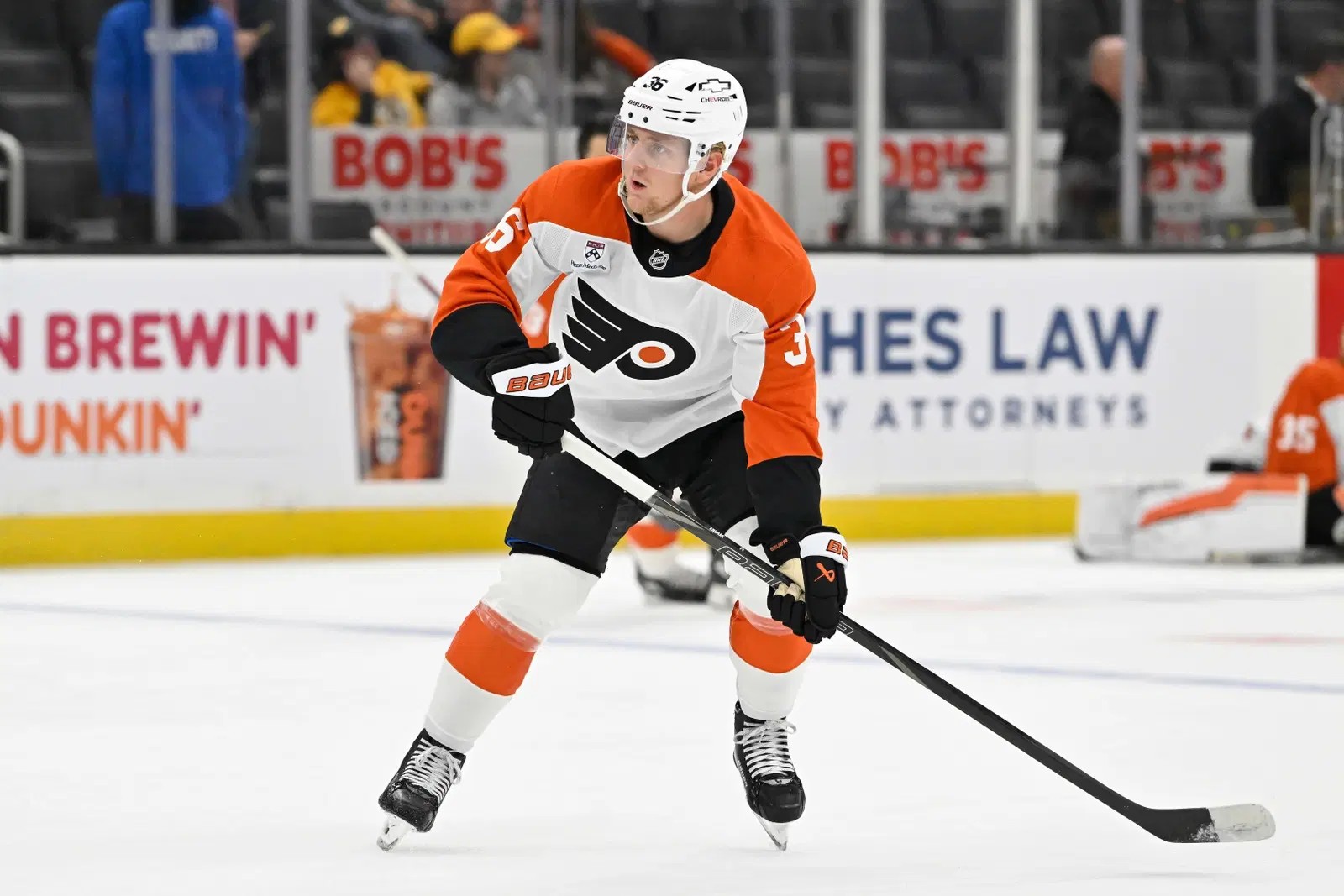
The Maple Leafs are hoping that Emil Andrae can add a few much-needed elements to their blue line this upcoming season: youth/upside, mobility, and puck-moving ability.
Whether Andrae — 24 years old and with only 107 NHL games to his name — can supply those elements consistently at the NHL level is still to be decided. But as an organization relatively shy on blue-chip defense prospects or promising young pro defensemen realistically pushing to make the NHL jump in the near future, the Leafs badly needed to add some younger NHL-ready upside to their backend. Unless a Ben Danford or William Villeneuve surprises everyone by claiming a job out of camp, Andrae will start the season as the only member of the Leafs’ blue line under the age of 30.
Andrae was the centerpiece in the Leafs’ five-piece trade with Philadelphia that sent Joseph Woll and Simon Benoit to the Flyers in exchange for Andrae, Samuel Ersson (who was flipped to Ottawa), and a 2026 third-round pick. The Leafs then signed him to a two-year contract worth $1.55 million annually—a team-friendly number well below the $2.1 million AFP projection. They will retain control over the asset at the end of the contract, when Andrae will be an RFA with arbitration rights.
The contract is firmly in prove-it territory, which is fair and appropriate. At 5-foot-9, there will always be questions about how high Andrae can climb in an NHL blue line’s pecking order and his viability in playoff-style hockey, in particular. But there is also enough evidence—both in the data and the eye test—to suggest there is some hope he could become more than just a depth option.
Andrae’s start in Philly
Andrae, a 54th overall pick in 2020, developed in Sweden, spent his first full North American season primarily in the AHL, and then received an extended NHL opportunity in 2024-25.
Andrae recorded a goal and seven points in 42 games while averaging 17:21. He was yo-yo’d between Philadelphia and Lehigh Valley, but the underlying results were encouraging: The Flyers controlled nearly 55 percent of the expected goals and over 53 percent of the high-danger attempts during his five-on-five minutes.
According to PuckIQ, only 22 percent of his five-on-five ice time came against top competition, the lowest share among Flyers defensemen in 2024-25 (unsurprisingly). Nevertheless, he showed enough puck-moving skill, competitiveness, and mobility to establish himself as a legitimate NHL option.
There were also signs of the challenge facing a rookie defenseman with a 5-foot-9 frame; there are the physical limitations, and then there is also the fact that they tend to receive less rope from their coaches in general. A rough December game against Columbus—in which Andrae lost position on two goals against and took a heavy hit from Mathieu Olivier—preceded three consecutive healthy scratches. He returned for one game before the Flyers assigned him to Lehigh Valley, with then-Flyers head coach John Tortorella stating that the demands of the NHL game had “gotten too rich for him.”
Andrae’s first full-ish NHL season
Andrae entered Rick Tocchet’s first training camp in Philadelphia competing for a bottom-pair position, but he again started the season in the AHL. His size and left-hand shot undoubtedly worked against him; Broad Street Hockey noted that his camp was reasonably good, but it wasn’t strong enough for Tocchet to overlook the profile he preferred for the sake of blue line balance.
Andrae returned to Philadelphia shortly after the season began and initially received limited minutes. Against the Panthers, he played only 10:22 (though Philly owned seven of the eight five-on-five shot attempts with him on the ice). He was sent down after one game and recalled again in early November; Tocchet clarified that the demotion was driven by the Flyers’ need to recall a centerman (Jacob Gaucher) due to Sean Couturier’s injury status, not Andrae’s performance; Andrae was waiver-exempt at the time.
Once given a sustained run of playing time, Andrae began to secure his spot. Tocchet praised his confidence and breakout ability, saying the Flyers needed to find more minutes for him. By late November, Andrae moved onto the second pair with Jamie Drysdale, and Andrae played a 20-game stretch leading up to the new year where he averaged just under 20 minutes a game.
Neither Andrae nor Drysdale is physically imposing, but the pairing compensated through their mobility, anticipation, and puck movement. Tocchet highlighted their ability to think their way through defensive situations, pointing specifically to Andrae reading cycle plays and killing them before they developed. Tocchet also praised Andrae’s “swagger” with the puck through the neutral zone and along the offensive blue line.
“Hockey IQ and quickness. They’re not going to go flying in there and hammer guys. Emil will try it sometimes, and Jamie. But with their brain and their quickness, you can outthink somebody on a cycle. I saw Emil a couple of times cut off resets before the cycle even happened. That’s a huge play.”
Philadelphia decisively won Andrae’s five-on-five minutes with Drysdale, who was his most common partner during the 2025-26 season. The pair didn’t dominate every shot or expected-goals metric, but they consistently landed on the right side of the five-on-five goal ledger.
At his best, Andrae finds first-pass outlets cleanly, can skate a puck out when the first pass is unavailable, and is confident activating into open ice. He isn’t a dynamic point producer—he recorded two goals and 13 points in 61 games, and barely touched the power play—but he can ably contribute to positive offensive sequences.
After the trade to Toronto, Flyers GM Danny Briere described Andrae as a “very high competitor” who doesn’t back down from anybody. During his first extended NHL opportunity, Andrae became tangled with Matthew Poitras during a puck battle and, believing he had been slew-footed (“I was pissed,” Andrae said after the game), he responded by punching the Bruins forward in the face. Andrae won’t physically overpower many opponents, but he does not back down. Notably, he is 5’9 tall but weighs in at around 190.
Overall, the Flyers outscored the opposition 36-22 with Andrae on the ice at five-on-five in 2025-26 (+14), compared to 125-127 without him (-2). They also won the high-danger goal battle 23-9. Those are excellent results, and his partner splits are generally encouraging. He decisively won his minutes alongside Drysdale, while the results with most of his other regular partners were also respectable.
The caveat is that Philadelphia’s goaltenders posted a .936 five-on-five save percentage behind Andrae. No defenseman can bank on receiving that level of goaltending indefinitely, and his expected-goal results were much closer to level. Still, Andrae’s territorial results were solid. The goaltending helped produce a sparkling goals-for percentage, but the whole thing was by no means a total illusion.
It’s also worth noting that his 2025-26 season was not one smooth ascension. Andrae’s play slipped around the turn of the calendar, prompting a healthy scratch against Calgary. He then fell out of the regular rotation in late January, which meant he went a full month without playing across the Olympic break.
Tocchet believed Andrae played his best hockey immediately after his recall, when he was breaking out the puck effectively and confidently skating it out of trouble. As the season progressed, Tocchet felt Andrae began trying to do too much, specifically pointing to passes through the middle of the ice and instances when he was caught out of position:
“I think he played his best hockey when he was first called up. I think he was obviously good on the breakouts, good on wheeling the puck… It’s just stuff he tries too much—making passes in the middle of the ice or being out of position, things like that.”
Andrae returned to the lineup after the break and helped Philadelphia’s playoff push. In March, after sitting for two games, he jumped into the rush and scored in a win over Minnesota while continuing to move the puck efficiently in limited minutes.
In the playoffs, Andrae’s role was scaled back even further. He played only 9:39 in Game 1 against Pittsburgh before missing Game 2 with an upper-body injury. He was not on the ice for a five-on-five goal for or against during the postseason — he did pick up an assist on a goal scored with a delayed penalty — and he averaged just 11:05 per game over his four appearances. By the second round, prospect Oliver Bonk received opportunities ahead of him, underlining the fact that Andrae’s long-term position in Philadelphia was very much up in the air.
The Flyers’ decision to move him was not necessarily a clear verdict that he could not capably contribute to an NHL blue line. Their blue line already featured a few smaller, mobile defensemen in Drysdale and Cam York, and the organization has higher-pedigree youngsters in Bonk and David Jiricek pushing for NHL jobs. Andrae became the expendable piece in a crowded group.
Andrae’s fit for the Leafs in 2026-27
Andrae should enter training camp with an inside track on a bottom-pair role with the Leafs. He is by no means a nightly lineup lock yet, but he is now waiver-eligible, and the Leafs likely did not make him the primary asset in the Woll trade and sign him to a two-year contract just to scratch him out of camp.
In terms of pairing options, fellow Swede Oliver Ekman-Larsson is a veteran with more size/length who can play either side and drive a third pairing. Ekman-Larsson fared just fine on his off-side at points last season, even if he really shouldn’t be deployed there in difficult minutes.
Andrae has some NHL experience playing the right side next to Nick Seeler, although (unsurprisingly) most of his best work came on his strong side beside the right-shot Drysdale. If Jim Hiller wants to keep OEL on the left, Andrae could potentially receive off-side minutes next to him or Morgan Rielly, if the coaching staff plans to actually reduce the latter’s responsibilities. But starting Andrae on his offside next to a rehabilitation project (Rielly) in new environs is far from ideal and should probably be avoided. Personally, I lean toward OEL to start with.
Andrae’s role shrank as the intensity ramped up down the stretch and into the playoffs, which is noteworthy, especially given his size limitations. But he was also navigating his first full-ish NHL schedule, and it was a particularly challenging/compressed one at that.
The Leafs should start Andrae in a managed role, give him a stable partner, and let him play through the occasional mistake. He needs to prove he can hold up physically and mentally over a full season, but he might help them move pucks and play on the right end of the rink more often while contributing enough offensively at five-on-five to justify a regular role.
Andrae is small and inexperienced, but he is also young, mobile, competitive, and has a track record of winning his NHL minutes. After icing an older, heavier blue line that too often struggled to move the puck cleanly last season, the Leafs’ coaching staff should give Andrae enough rope to properly acclimate to his new environment.
Following a season in which Simon Benoit finished -22, Andrae simply winning his minutes for the Leafs in a bottom-pairing capacity would be a big step forward over last year.