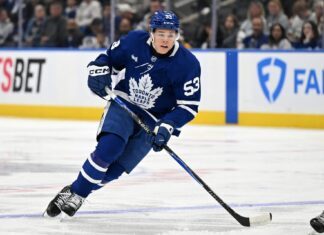



















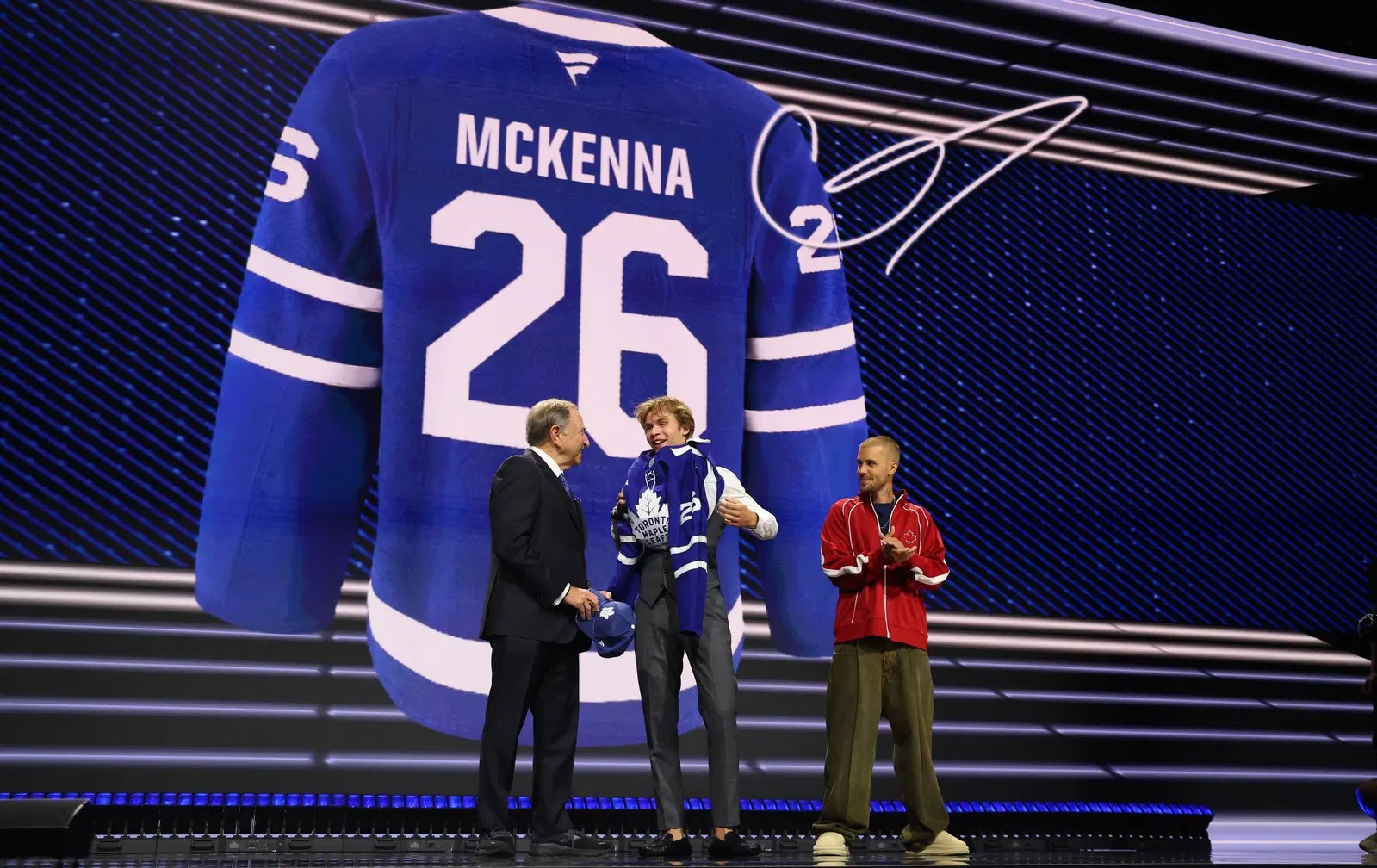
Gavin McKenna could be anything from a supporting piece to a game-breaking star in his rookie season, and how the Maple Leafs manage the upside and uncertainty surrounding their new young star matters far beyond just 2026-27.
A wide range of plausible outcomes exists for McKenna this season. In the dream scenario, McKenna follows a Patrick Kane-like trajectory, immediately translating his rare playmaking ability into high-end NHL production. Kane stepped directly into the league as an undersized first-overall pick and recorded 21 goals and 72 points in 82 games as an 18-year-old, winning the Calder Trophy.
Sticking with the same organization, Connor Bedard recorded 22 goals and 61 points in 68 games on a terrible Chicago team, establishing himself as its most dangerous offensive player almost immediately.
McKenna will enter the league on a better team than either of those Blackhawk rookies. He will not immediately be their most dangerous offensive player. He will play with proven NHL stars and join an organization that is ostensibly serious about competing for the playoffs. If his gifts immediately translate, though, it is not inconceivable that he produces at a 60+ point pace and becomes one of the Leafs’ most important offensive players before his rookie season is over.
But there is also a more grounded scenario, one that would not be a disaster or necessarily change McKenna’s long-term outlook. Jack Hughes entered the NHL as a supremely talented but physically immature first-overall pick and recorded seven goals and 21 points in 61 games as a rookie. He often looked overwhelmed; his skill was evident, but he couldn’t consistently create the space to use it.
McKenna could land almost anywhere between these poles, which makes him the biggest wildcard on the Leafs’ roster entering 2026-27.
The NHL adjustment
The biggest challenge facing McKenna is how quickly the 18-year-old can adapt to the baptism by fire facing him in a few weeks’ time: the limited time and space available against defenders with NHL speed, skill, size, and physicality.
Naturally, at Penn State, the fancy dangle sometimes backfired when the simpler play was available. He could drift to the perimeter when games became more physical. His engagement away from the puck improved as the season progressed, but it remains a work in progress, and he is physically limited.
At 5’11 and roughly 170 pounds at the combine, McKenna is clearly not going to overpower NHL defensemen. He will need to learn how to create space through his puck poise, deception, changes of pace, and quick decisions. He will also unavoidably need to play more directly at times, enter traffic, and remain involved when he is not on the puck.
The encouraging part is that McKenna has already demonstrated the ability to adapt quickly. His tumultuous first half at Penn State did not break his confidence; it made him work harder until he figured it out. He began holding weekly video sessions with his team, reviewing every shift and examining the different decisions available to him. His game and overall engagement improved significantly in the second half.
His off-ice preparation also appears to be advanced for his age. McKenna declined an opportunity to join Canada at the World Championship, probably recognizing that he was unlikely to receive a major role on an NHL veteran-laden roster and choosing instead to prepare for the combine. He then tested as one of the better-conditioned players in the draft class. That doesn’t mean he is physically ready for everything the NHL will throw at him, but it suggests he understands the work required to get there and is off to a good start.
Mentally, McKenna also appears well equipped for the Toronto market. He has lived under intense scrutiny for years, and he deliberately chose a more difficult developmental challenge in the NCAA. He embraces the spotlight and carries himself with a little swagger. He is introspective and critical about his own game, yet quite secure in who he is and what he’s capable of.
That is a good starting foundation. Of course, everyone has a plan until they get punched in the face. A few disappointing games at Penn State are not the same as going seven or eight NHL games without scoring in Toronto, where there will be round-the-clock coverage about whether he should move down the lineup or even be in the NHL. The Leafs will have to help McKenna navigate it all.
The balancing act for Jim Hiller and co.
The primary objective with McKenna extends well beyond this season. The Leafs want to return to the playoffs immediately, and McKenna could certainly help them do it. But whether he records 35 or 65 points as a rookie is less important than whether the organization puts him on the path to becoming the best possible version of himself in five years’ time when the current core is well past its prime.
That could create a tricky line to walk for Jim Hiller, who was on Mike Babcock’s staff when Auston Matthews, Mitch Marner, and William Nylander broke into the league full-time in 2016-17. Matthews scored 40 goals and 69 points, while Marner and Nylander each recorded 61 points. The organization embraced the skill and exuberance of its young players, lived with the mistakes, and made the playoffs one year after finishing dead last. But the team had no competitive expectations at the time; they were playing with house money.
Hiller has also seen the other side of young-star development when he joined the LA bench when the Kings were a 100+ point playoff team and second-overall-pick Quinton Byfield was early in his NHL career.
McKenna will need standards and patience in equal measure. He cannot receive a free pass for every mistake, but he also cannot play scared of making one. He needs room to experiment, fail, learn, and try again. There will be nights when he makes a play that only a handful of NHLers can make. There will be others when a veteran defenseman closes on him, knocks him off the puck, and sends the play the other way for a Grade-A scoring chance or goal against.
The Leafs should be careful not to overexpose or overload him. McKenna should receive meaningful offensive minutes and power-play time, but the benefit of the Leafs’ current situation — they have multiple established stars up front — is that he does not need to carry a line, face the opposition’s best players every night, or be responsible for throwing the offense on his back at 18 years old.
The lineup fit
The most tantalizing linemate possibility is also the most obvious one: McKenna alongside Auston Matthews. This is not exactly rocket science: one is an elite playmaker who can manipulate coverage and pass the puck into dangerous areas, the other is one of the greatest finishers of his generation.
Leafs AGM Ryan Hardy has already floated the idea, noting that McKenna’s line-rush ability and playmaking through the middle of the ice could complement Matthews quite nicely. Matthews would also be a logical mentor—an established captain and former first-overall pick who entered T.O. with similarly enormous expectations.
But placing McKenna on the top line would obviously immediately raise the temperature around him. As Anthony Petrielli fairly noted, the Leafs cannot instantly trot him out as Matthews’ new running mate and then wonder why the world expects immediate star production.
A more measured starting point could be a sheltered scoring line with John Tavares. The Leafs have built enough checking depth that they should be able to find a line capable of absorbing a share of the defensive-zone starts and matchup work. Matthews’ line will naturally command significant matchup attention. That would allow Hiller to deploy McKenna and Tavares — who, at this point in his career, isn’t an elite play driver that can win the more difficult minutes at five-on-five — against weaker competition with a heavier offensive tilt.
Playing alongside a center of Tavares’ calibre — he may be past his peak, but he is still coming off a 30-goal, 70-point season — against softer opposition, along with power-play opportunity alongside a collection of elite offensive weapons, sounds like a pretty peachy spot to start his career.
Stylistically, McKenna likes to hold onto the puck, slow possessions down, and wait for seams to open. Tavares remains excellent at finding the quiet areas, working below the hashmarks, winning battles around the net, and finishing his opportunities.
Tavares might also be the best possible veteran mentor for McKenna. He knows what it is like to grow up in Canada as the next big thing, to enter the league as a first-overall pick at 18, and to serve as captain in two demanding hockey markets. He’s built his reputation on unbeatable preparation and professionalism.
The line placement will evolve, but the key is that McKenna is protected situationally without losing him on the bench, and rewarded as appropriate without immediately expecting him to be a finished product.
A genuine game-breaker talent developing in the Leafs’ midst
There is always the potential for a painful learning curve when an 18-year-old steps directly into the NHL, let alone Toronto, with the hype and expectations of a Gavin McKenna.
There is also an enormous amount to be excited about. This is a potential game-breaking-level talent arriving at the beginning of his career while the team’s established stars are still trying to win. McKenna is not joining a club in the middle of a five-year teardown. He is entering a dressing room with Auston Matthews, William Nylander, John Tavares, and Sergei Bobrovsky. He will play meaningful games immediately and should have the opportunity to learn from players who understand elite NHL performance and navigating the pressures of Toronto.
Maybe he takes the league by storm. Maybe the lack of space and the NHL physicality expose his rough edges, and his first season looks more like Hughes’ than Kane’s. Most likely, he provides flashes of brilliance, stretches of real production, and periods when he looks every bit like an 18-year-old adjusting to the hardest league in the world.
Whatever the immediate outcome, the Leafs cannot lose sight of the bigger picture. They need to help McKenna preserve his confidence and creativity while teaching him the habits needed to thrive in the NHL. They need to resist overexposing him while still giving him enough responsibility to grow.
If they get the balance right, the sky is the limit.