



















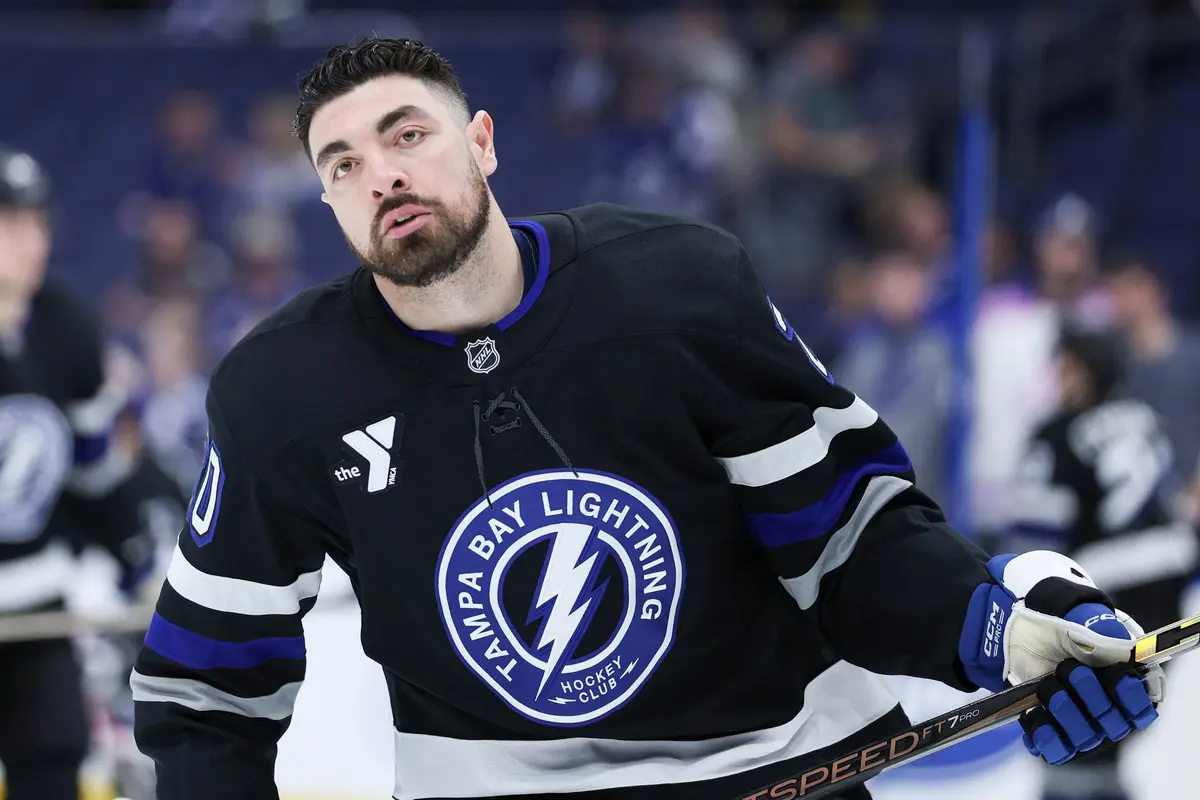
Nick Paul’s final season in Tampa Bay was either an injury-riddled aberration or the first warning sign for a 31-year-old forward who had previously been quite healthy and consistent. After trading Dennis Hildeby, a 2027 fourth-round pick, and a 2028 third-round pick to acquire him, the Maple Leafs are betting on the former.
Paul entered 2025-26 coming off three productive seasons for the Lightning while appearing in 80, 82, and 76 games. The Mississauga native set career highs with 24 goals and 46 points in 2023-24 before following it up with 22 goals and 41 points in 2024-25. He averaged 17:16 and 16:27 per game in those two seasons, respectively, establishing himself as a dependable middle-six forward who can play center or wing, chip in on both special teams, and complement skilled linemates.
Almost none of that carried over into last season. Paul underwent wrist surgery during the preseason, costing him the first 19 games. After returning in late November, he recorded six goals and 12 points in 34 games before suffering a lower-body injury on February 1, which sidelined him for another 11 games.
By the time the season ended, Paul produced just seven goals and 15 points in 51 games while averaging 13:41 per night—his lowest ice time since his early NHL seasons in Ottawa. His shooting percentage fell from above 15 percent in each of the previous two seasons to 10.3 percent, and he generated fewer than 1.5 shots per game.
A big part of the story is that Paul didn’t return to his old role after pre-season surgery. The Lightning had re-acquired and subsequently re-signed Yanni Gourde and used him as their third-line center. With Brayden Point and Anthony Cirelli in the top six, Paul no longer owned a clearly defined job. Instead, he bounced around the lineup with a revolving cast of linemates.
His most common five-on-five combination—with Dominic James and Oliver Bjorkstrand—played only about 64 minutes together. Paul also spent stretches with various combinations of Bjorkstrand, Corey Perry, Jake Guentzel, Gage Goncalves, Zemgus Girgensons, Jack Finley, Curtis Douglas, Scott Sabourin, Brandon Hagel, and Nikita Kucherov. Some nights, he centered skilled scorers; other nights, he played with depth players. There was very little continuity in either his linemates or the purpose of his line.
Paul’s role declined even further in Tampa Bay’s first-round playoff series against Montreal, where he played essentially fourth-line minutes and finished without a point on seven shots in six games while averaging just 11:19 per night. After playing over 13 minutes in each of the first two games, Paul logged only 7:58 and 7:33 in Games 3 and 4, respectively, before missing Game 5 due to illness and playing ~12.5 minutes in Games 6 and 7.
Notably, Paul continued to take on a consistent faceoff load. He took 557 draws in 51 games—nearly 11 per night—and won 53.9 percent of them. He took at least eight faceoffs in 35 of his 51 games and three or fewer only once. He spent some time on the wing and there were fluid combinations in which Paul lined up alongside a natural center, but he still spent plenty of time down the middle.
His territorial results were also better than his minus-15 rating suggests. Tampa Bay controlled around 51 percent of the five-on-five shot attempts with Paul on the ice, but his lines were outscored 30-18. The Lightning shot only 7.7 percent during those minutes, while their goaltenders stopped 87.7 percent of the shots they faced — an extremely low on-ice PDO of 95.4.
It would be convenient to wave away the minus-15 as entirely bad luck, but Paul’s own play did contribute to the problem. His offense dried up, his shot generation fell, and Tampa steadily reduced his workload. Still, the underlying results don’t scream that this is a player who was caved in defensively. His lines generally held their own territorially while suffering from poor finishing and goaltending.
Paul’s special-teams responsibilities were secondary by this point. He averaged 1:13 per game on the power play, recording one goal and three points, primarily as a net-front option. He had previously gained more traction in that role, scoring nine power-play goals and 14 power-play points during his career season in 2023-24, but he was not a regular member of the top unit.
His penalty-killing usage has also declined steadily over time. After averaging 1:54 per game following his arrival in Tampa in 2021-22 and 1:25 the following season, Paul’s PK time dropped to 41 seconds in 2023-24, 36 seconds in 2024-25, and only 24 seconds last season. He has the size, reach, and faceoff ability to contribute there, but he has not recently carried a major shorthanded workload.
The Leafs signed Sergei Bobrovsky, saw Artur Akhtyamov emerge in the AHL, and faced a waiver-related logjam with Hildeby in the fold. They also had a glaring vacancy at third-line center. There is nevertheless a risk in surrendering a promising, $842k (for two more seasons) goaltender who was good in the NHL last season in tough circumstances, along with two mid-round picks, for a player coming off a poor, injury-disrupted season.
As Anthony Petrielli noted in his offseason review, Paul’s value to the Leafs depends heavily on whether he can rebound as a center. If he ends up primarily on the wing while bouncing around the lineup, the Leafs will have paid assets for a type of player who could’ve been acquired for nothing but cash in free agency (wingers Michael Bunting, Vladimir Tarasenko, and now Chris Kreider are all hanging around the UFA pool today, for example).
Paul’s 2026-27 Outlook
Paul’s path to becoming an important Maple Leaf is straightforward: Stay healthy, claim the third-line center position, and give the team enough offense to support a legitimate three-line attack.
At 6’4 and roughly 230 pounds, Paul brings elements that are always in demand down the middle. He can protect the puck, drive the net, win draws, defend responsibly, and create space for more dynamic wingers. He is not an especially creative playmaker, but he has enough skill around the net to complement one. That could make him a sensible center for Easton Cowan (or maybe Jack Roslovic), depending on how Jim Hiller configures the lineup.
The Leafs might also be able to offer Paul something that eluded him during his final season in Tampa: stable role definition. Matthews and Tavares will occupy the top two center positions, but there is an obvious third-line job available. The Leafs added several forwards capable of playing center or wing, including Colton Sissons, Teddy Blueger, and even Jack Roslovic, but Paul arguably possesses the best combination of size, an established offensive track record, and two-way ability for a traditional 3C role.
That doesn’t mean the position should be handed to him. Paul needs to show that last season’s results were caused by the wrist surgery, lower-body injury, and constant movement through Tampa’s lineup—not the beginning of a real decline. As mentioned, his track record before last season was one of durability rather than persistent injury trouble.
If Paul can settle into a consistent line and return to the 15-to-20-goal, 40-point range, his contract has a chance to become one of the Leafs’ better pieces of business. Centers are always at a premium, particularly ones with Paul’s size, faceoff ability, and history of production. Under a rising salary cap, $3.15 million for that player over the next three seasons would be a boon.
There is also value in the flexibility Paul provides over an 84-game schedule. He can move to the wing when needed, fill in higher in the lineup (e.g., Paul-Tavares-Nylander might be worth a look at some point), take defensive-zone draws, provide a net-front presence on the second power-play unit, and serve as an additional penalty-killing option. Even without returning to career-high production, a healthy Paul can help the Leafs construct a more balanced top nine/less top-heavy forward group.
Tavares is 36 years old, while Matthews’ recent injury history made it highly risky–frankly, it would’ve unacceptable–to enter a season without some more experienced C depth behind these two. A healthy Paul with his pre-2025-26 track record gives the Leafs a legitimate NHL center who can credibly move up the lineup when needed. Whether they would have been better served betting on a younger player on the other side of the age curve—such as a Mavrik Bourque—remains to be seen, but the need was obvious.
A healthy Paul producing 40 points as the Leafs’ third-line center, or while sometimes effectively complementing good players on the LW, is a valuable player on an excellent contract. An aging Paul scoring closer to last season’s rate while drifting between center and wing would make the acquisition cost more difficult to defend.
The Leafs are betting that 2025-26 was simply one of those seasons: a disjointed, injury-riddled outlier for a player whose previous three years established a much higher and more durable baseline. If they are right, they may have secured three seasons of an in-demand commodity at a bargain price.