



















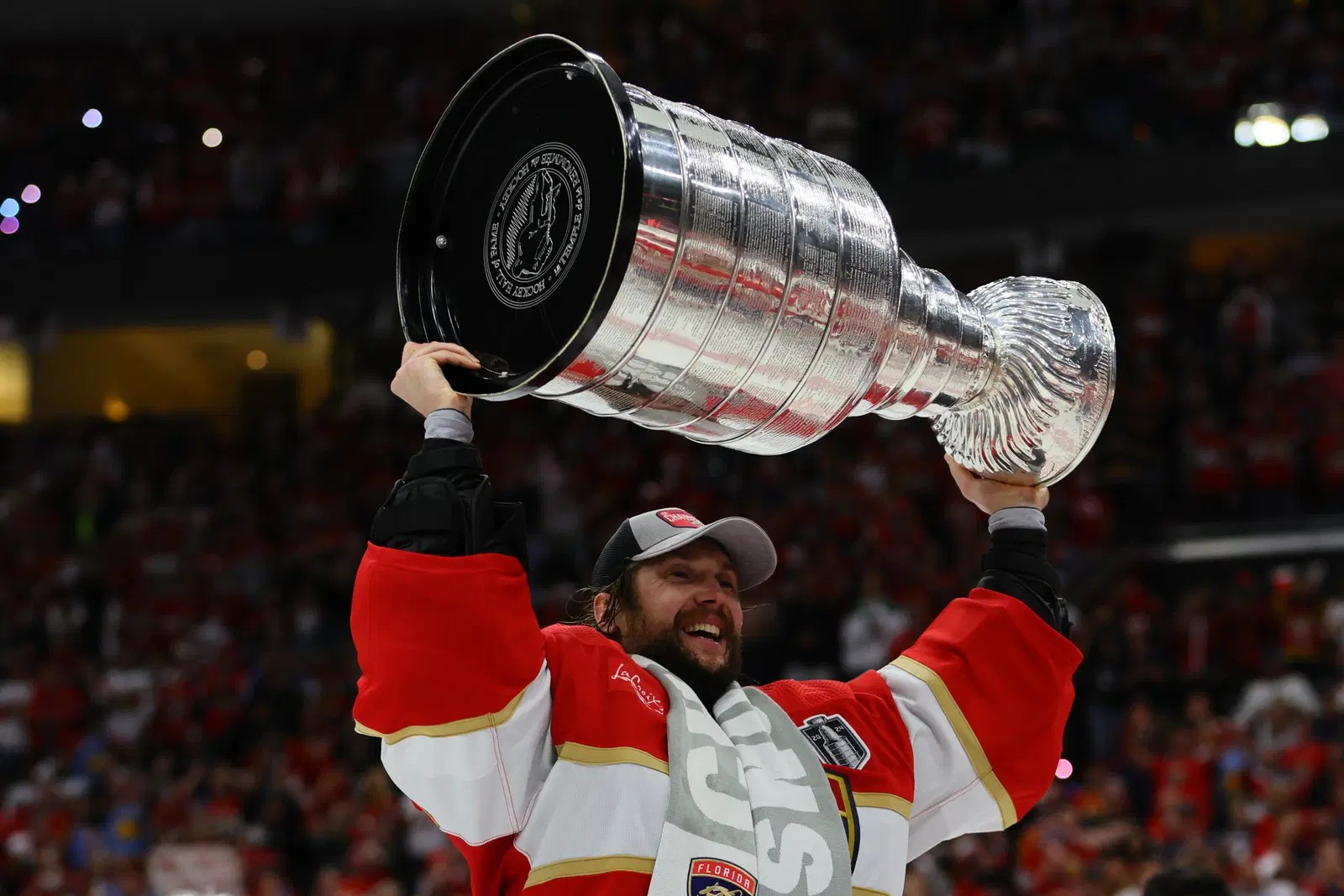
Through the first 15 years of his NHL career, Sergei Bobrovsky built a stonewall Hall of Fame résumé:
- Two Vezina Trophies
- Over 450 regular-season victories
- Three consecutive Stanley Cup Finals, including back-to-back championships
- 44-21 with a .912 save percentage and six shutouts in 65 playoff appearances between 2023 and 2025
- Evolving Hockey credited him with 41.25 goals saved above expected over those three postseasons (!).
Leafs fans hardly require a history lesson on Bobrovsky’s ability to take over a playoff series. In 2023, he posted a .943 save percentage as Florida eliminated the Leafs in five games. Two years later, he shut out the Leafs in Game 4 and allowed one goal in the Panthers’ infamous Game 7 blowout in Toronto (though I think Vesa Toskala could’ve secured that G7 victory for Florida with the Leafs’ general performance).
Bobrovsky’s greatness is rooted in much more than just raw athletic ability. His meticulous preparation, conditioning, durability, and relentless work ethic are legendary throughout the league. He treats the position as a 24/7/365 obsession, allowing him to handle a workload that would wear down many younger goalies.
“The only guy I will be recruiting — and I hope I don’t have to recruit him — is Bob. We cannot lose him. He’s our guy. He is going to get us back to where we want to be. He’s the most important piece of our team, with what he has done over the past couple of years. It’s the character, the work ethic, the drive. He sets the tone on and off the ice. I don’t care what age he is; he is the backbone of this team. If we’re going to get back there, we’re going to need him.”
– Matthew Tkachuk
The usual caveats apply about a teammate’s endorsement =/= objective player evaluation, but Tkachuk’s words capture the stature and sway Bobrovsky held inside one of the league’s most successful dressing rooms. He wasn’t simply the starting goalie off doing his own weird goalie things with the backup and the netminding coach; his habits helped set the franchise’s standard, and when the Panthers’ aggressive style broke down, they trusted him to clean up the mess. During their two championship seasons, no team surrendered more breakaways than Florida.
Aleksander Barkov offered a similarly glowing assessment recently, emphasizing the daily standard Bobrovsky established in Florida:
“When he speaks, everyone listens. At the gym, he’s always working hard. On the ice, working really hard.
“We’re gonna miss him a lot as a person. As a goalie and a person, he was a great person, really that type of guy who you look up to every single day.
“Even at his age. I think he’s what, 37, 38, he feels like and looks like he’s early 30s, maybe even late-20s. That’s what you want to be as a perfect human being and athlete.”
– Aleksander Barkov
There is no dressing up Bobrovsky’s 2025-26 performance, though. His save percentage fell from .905 to a career-low .877, his goals-against average climbed to 3.07, and the Panthers missed the playoffs. MoneyPuck graded him at -12.2 goals saved above expected, although Evolving Hockey’s model was considerably less harsh at -1.75.
The defensive environment in front of him also deteriorated. Aleksander Barkov, Matthew Tkachuk, Seth Jones, and Brad Marchand all missed significant time, and Florida slipped from an elite defensive team to roughly league average by multiple public models. Bobrovsky stayed healthy and started 51 games, but he played behind a badly depleted team after three consecutive deep postseason runs.
The compressed Olympic schedule probably compounded the problem. As Anthony Petrielli pointed out, from opening night until the Olympic break, Bobrovsky ranked fourth in the NHL in starts. Two of the three goalies ahead of him—Juuse Saros and Dustin Wolf—also carried sub-.900 save percentages into the break, while Karel Vejmelka sat at .903. Bobrovsky’s .871 was clearly the worst mark of the group, but the broader pattern is noteworthy: heavily worked starters probably struggled more than usual with the unique grind of the 2025-26 NHL schedule.
At some point, mileage and age will stop being contextual factors and will become the explanation for the inevitable decline. Bobrovsky averaged 54 starts per season over his final four years in Florida, on top of 65 playoff games between 2023 and 2025, and he turns 38 before the season starts. In the meantime, the Leafs are betting last season was more reflective of the difficult environment, not the start of an irreversible decline.
Bobrovsky’s 2026-27 Outlook
The Leafs signed Bobrovsky for three years at a $7 million cap hit because they desperately needed a proven goaltender who could reliably play NHL games, and the UFA goalie market was otherwise not at all appetizing.
Anthony Stolarz has generally stopped the puck at a high level when available, but his injury record makes it difficult to project him for more than 30 games. Artur Akhtyamov is an intriguing young goalie, but it’s a particularly difficult position to project based on AHL success, and he remains completely unproven in the big leagues. Having moved Joseph Woll, it’s understandable that John Chayka’s management group felt they couldn’t enter another season running back their goaltending plan and hoping it would hold together physically.
Whatever questions surround Bobrovsky’s recent decline in performance, his availability has almost never been among them. He has reached at least 50 appearances in each of the past nine seasons, excluding the Covid year, and played 52 games last year despite everything going wrong in Florida.
New Leafs VP of Sport Performance Andy O’Brien has described Bobrovsky’s biological age as younger than his chronological age:
“He is young because he takes such good care of himself. He doesn’t have the same wear and tear as a goalie who is 37-38 years old.”
– Andy O’Brien
No doubt, the Leafs aren’t acquiring your typical 38-year-old goalie. That doesn’t make Bobrovsky immune to aging, but if anyone is equipped to defy the normal curve a little longer, his history makes it hard to bet against him.
Additionally, the value should extend beyond his own starts. Akhtyamov is entering a critical stage in his development, and there’s no better veteran goalie for him to observe daily. Bobrovsky arrives in shape, can’t be outworked, stays ready, and plays. For a Leafs organization trying to build a more demanding, accountable culture, he should help set a higher standard.
The existing relationship with Stolarz should also ease the transition both ways. The two shared Florida’s crease during the Panthers’ first Stanley Cup season in 2023-24, when Stolarz produced a .925 save percentage in 27 appearances while Bobrovsky remained the clear starter. Paul Maurice has spoken glowingly about their partnership:
“I know that Sergei loved [Stolarz] as a partner. He told me that directly. We loved him here in the room.
“We would’ve loved to have kept him… We loved the guy. He was good for us.”
– Paul Maurice
The Leafs do not need to recreate the workload Bobrovsky carried during his final season in Florida. With no Olympic break compressing the schedule and a capable partner in Stolarz plus AA in the minors, the Leafs should have a path to keeping Bobrovsky closer to 45-50 starts, provided the overall health is generally reasonably in their favour. They should be able to somewhat preserve him for the games that matter rather than wringing every possible regular-season start out of him.
As we all warmly remember on this site, Ed Belfour arrived in Toronto at 37 after two declining seasons in Dallas and delivered two outstanding years. Dominik Hasek, Roberto Luongo, and Martin Brodeur also remained legitimate NHL starters into their late 30s or beyond. Bobrovsky’s talent, résumé, and conditioning belong in that class, even if the comparison does not guarantee the same result.
Following Tampa Bay’s three consecutive trips to the Cup Final, Andrei Vasilevskiy’s performance eventually dipped under the cumulative workload before he returned to elite form in 2025-26. The optimistic case is that a longer summer — his first of any length since 2022 — and a lighter schedule produce a similar recovery for Bobrovsky. The obvious, less encouraging counterpoint is that Bobrovsky’s decline was steeper and arrived when he was nearly eight years older.
This contract introduces plenty of downside risk. If the .877 save percentage was the beginning of the end, Bobrovsky is on the books for $7 million AAV through his age-40 season.
Even dependable league-average goaltending would probably qualify as an acceptable enough regular-season return in year one, although the Maple Leafs did not sign Sergei Bobrovsky just to eke by in the regular season.
The Leafs are betting on the habits, durability, competitive makeup, and playoff pedigree of one of the greatest goalies of his generation. Many of those qualities should transfer cleanly from Florida to Toronto. The one thing nobody can know yet is also the only question that ultimately matters: When the Leafs need Bobrovsky to steal a game down the stretch—or perhaps a playoff game, or a playoff series—how much of the old Bob magic is still left in there?